
Workshop Facilitation . Service Design
Co-Creating a CX Vision
Across Service, Tech and CX
How I designed and facilitated a cross-functional workshop series that gave SSE's stakeholders a unified customer service vision — and the values and behaviours needed to act on it.
Duration
Oct – Nov 2025
Team
Service, CX, Technology
Role
Project Lead
- 01 CONTEXT
A platform migration without a shared direction
In 2025, SSE began migrating its customer service operation to a new platform — one that would embed AI across service interactions for the first time. The technology decision had been made. What hadn't been established was what good should actually look like on the other side of it.
Without a shared definition of quality, teams from service, customer experience, and technology would each build to their own interpretation. The migration risked compounding existing service problems rather than addressing them.
Before any design work began on the platform itself, the question had to be asked: what does excellent AI-assisted customer service look like for SSE? This project was built to answer it — through structured facilitation, not assumption.
The problem with skipping vision
Platform migrations without a shared CX vision produce fragmented experiences. Teams optimise locally — for speed, for cost, for technical consistency — without a shared reference point for what the customer should feel at the end of it. A vision statement is not decoration. It is an alignment mechanism that makes every subsequent trade-off faster and more consistent.
- 02 DIAGNOSIS
Where SSE's customer service stood
Before asking stakeholders to imagine a future state, they needed to understand the current one. I compiled performance data across SSE's primary service channels and benchmarked against industry standards. This served a specific facilitation purpose: anchoring the workshop in evidence, not opinion.
Telephony
-
Average wait time of 38 minutes, with a high abandonment rate as a direct result
-
IVR messaging too verbose and complex — customers frequently mis-routed
-
Minimal progress updates between contacts, driving significant repeat call volume
-
Average case resolution time of 34 days — driven by poor email structure and prioritisation
-
Cases passed across multiple teams with no single point of ownership
-
Siloed working limits collaboration; customers receive inconsistent information
The data made the case before the room needed to debate it. Three external benchmarks were also presented to frame the business stakes:
Revenue Impact
80%
Faster revenue growth among companies that lead on customer experience vs those that don't
Loyalty Multiplier
6X
Longer customer retention among those who rate their experience a 10/10 vs lower-rated equivalents
Cost of a Bad Interaction
1 in 3
Customers who will leave after a single poor service interaction — with no second chance
Sector investment shift
50%+
Faster revenue growth among companies that lead on customer experience vs those that don't.

Presenting current state data before any ideation exercise is a deliberate facilitation choice. It shifts the conversation from abstract aspiration to grounded problem-solving and gives stakeholders a shared factual baseline to react from, rather than their individual assumptions.
- 03 WORKSHOP DESIGN
Four phases. One unified output.
The workshop was designed as a single facilitated session bringing together leads from service, customer experience, and technology. Each phase was sequenced deliberately: establish the stakes, build a shared language, define the vision, then translate it into actionable guidance.
PHASE 1
Ground
Current-state data and industry benchmarks presented to anchor the conversation
PHASE 2
Imagine
Futuristic thinking scenario: stakeholders map what customers see, feel, think and do
PHASE 3
Articulate
Collaborative vision statement built using a structured Do–For–Achieve framework
PHASE 4
Operationalise
Guiding principles translated into behaviours using the COM-B model
Phase1 - Grounding in the current state
The session opened with a factual presentation of SSE's current service performance. This was intentional: it prevented the workshop from defaulting to aspirational thinking disconnected from reality. Stakeholders could not argue about what good looked like without first acknowledging what wasn't working.
Phase2 - Futuristic thinking exercise
I introduced a future-state scenario set in 2030 and asked stakeholders to step into the customer's perspective. Using an adapted empathy mapping structure — what would customers see, feel, think, and do — groups surfaced the qualities that mattered most to them. This is where the raw material for the vision came from.

Phase3 - Building the vision statement
A vision statement is only useful if it guides decisions. To make the output actionable rather than decorative, I structured the co-creation around three questions: Do what? For whom? To achieve what? Groups drafted candidate statements, which were then synthesised into a single agreed version.
VISION STATEMENT -2030
"Through consistent, high-quality service and easy experiences, we keep our promises, rebuild trust, and strengthen lasting partnerships with every customer."
The facilitation required active synthesis work. Each team — service, CX, and technology — came in with a different lens on what the vision should emphasise. The final statement had to be specific enough to guide decisions, and broad enough to remain meaningful across three distinct operational contexts.
- 04 VALUES & PRINCIPLES
From vision to a set of working principles
A vision statement defines the destination. Values define what the organisation will and won't compromise on to get there. Guiding principles tell teams what to do when trade-offs arise.
Once the vision was agreed, I moved groups through a prioritisation exercise to identify the values that most authentically represented SSE's business. From these, principles were derived using a structured prompt: "Our customer service will meet the core value of _______ when we _________."
Value - Quality
Deliver proactive, consistent, customer-led service that empowers people and sets clear expectations every time.
Deliver proactive, consistent, customer-led service that empowers people and sets clear expectations every time.
Value - Transparency
Use data to make the right choices for customers and staff while giving tangible timescales that meet real needs.
Speak with clarity and honesty, ensuring customers always understand what's happening and what to expect.
The two values — Quality and Transparency — were not prescribed. They emerged from what the teams themselves prioritised in the futuristic thinking exercise, then validated through dot-voting. The principles below each value were written in the room, collaboratively, and represent a genuine cross-functional commitment rather than a top-down directive.
Why this structure matters
Values without principles are slogans. Principles without a vision are rules without a reason. This three-layer structure — vision, values, principles — gives every subsequent design and operational decision a reference point. The question "does this align with our vision?" becomes answerable because the criteria are explicit.
- 05 BEHAVIOURS
Translating principles into practice
Guiding principles only have value if teams know what they look like in practice. The final phase of the workshop connected the principles directly to SSE's known service pain points — asking: given what we know about how our service currently fails, what would acting on these principles actually require people to do differently?


COM-B: a framework for making behaviour change realistic
Identifying desired behaviours is straightforward. Understanding why those behaviours don't happen — and what needs to change to enable them — is the harder problem. I introduced the COM-B model to give stakeholders a structured lens for this.
COM-B proposes that for any behaviour to occur, three conditions must be met simultaneously: people need the Capability to do it (skills, knowledge), the Opportunity to do it (environment, systems, time), and the Motivation to do it (habit, belief, incentive). If any one is absent, the behaviour won't reliably occur — regardless of how clearly it's been defined.
C
Capability
Do frontline teams have the skills, knowledge and training to act on these principles? What gaps exist?
O
Opportunity
Do frontline teams have the skills, knowledge and training to act on these principles? What gaps exist?
M
Motivation
Do frontline teams have the skills, knowledge and training to act on these principles? What gaps exist?
Stakeholders were grouped and asked to brainstorm what tools, system changes, training and cultural shifts would be needed under each dimension. This moved the workshop output from a wall of good intentions to a structured set of enabling conditions — something the platform and operations teams could actually act on.


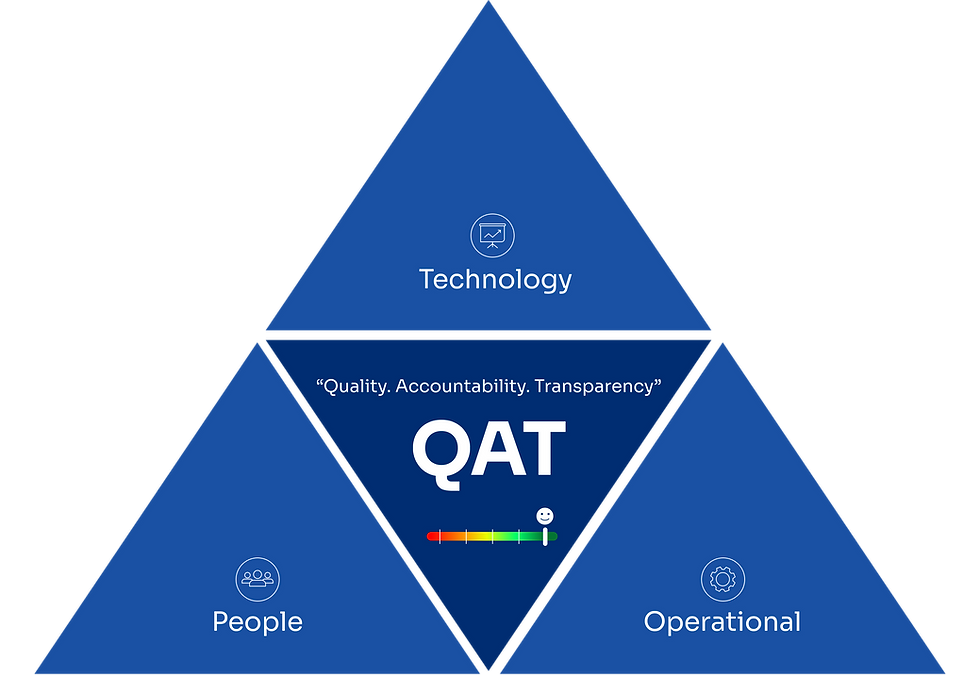
QAT — Quality, Accountability, Transparency: the three organising pillars that emerged from the session and now guide the platform design direction
- 06 OUTCOMES
What the workshop produced
The session delivered three concrete, documented outputs — each directly usable by the teams responsible for designing and building the new platform.
1
A collective vision statement
Co-created and agreed across service, CX and technology. Provides a shared reference point for every platform design and operational decision going forward.
2
Prioritised values and guiding principles
Quality and Transparency — identified and ranked by the stakeholders themselves, not prescribed. Each value is supported by two specific guiding principles to prevent abstract interpretation.
3
A COM-B behavioural enabler map
For each desired behaviour, a mapped set of capability gaps, system requirements and motivational levers — structured so platform and operations teams know what needs to be built or changed to make the principles real.
Guidance from the workshop has already been shared with frontline teams while the platform build continues. Early VOC data and customer sentiment scores are showing encouraging movement — a signal that aligning on direction before building has had an immediate, observable effect on how teams operate.
1 Vision
Agreed cross-functional statement guiding all platform decisions
2 Values
Quality and Transparency — stakeholder-prioritised, not prescribed
3 Outputs
Vision, principles and COM-B enabler map — all immediately actionable
REFLECTION
The clearest lesson from this project: alignment is a design problem. The stakeholders in the room were not resistant to change — they were operating without a shared framework for what they were changing toward. The workshop didn't create buy-in through persuasion; it created buy-in by giving people the structure to articulate and agree on what they already cared about.
If I were returning to this project, I would push to run the futuristic thinking exercise with real customers in an earlier phase — using their language as the raw material for the vision statement rather than inferring it from stakeholders. The outputs would be sharper, and the internal commitment would be stronger for having been grounded in direct evidence.
The broader point applies to any platform build: decisions made without a shared CX vision get made anyway — they just get made inconsistently, by whoever is in the room at the time. Investing in alignment upfront is not a delay to delivery. It is delivery risk reduction.