
Conversation Design . AI Product Design
AI Assistant in Customer Experience
How I redesigned SSE's chatbot from a dead-end navigation tool into a task-oriented AI assistant — rebuilding the conversation architecture, functional flows, and handoff mechanism to shift 80% of customer contact to digital self-service.
Duration
Jul – Sep 2025
Team
Design, Products, AI Engineers
Role
Project Lead
82%
Reduction in telephony & email traffic
45%
Increase in chat adoption
89%
Task completion rate (was 31%)
65%
Quick reply engagement (was 24%)
68
CSAT score (was 32)
- 01 BRIEF
A chatbot positioned as the solution but wasn't solving anything
SSE had a clear strategic target: shift 80% of customer contact away from telephony and email and into digital self-service. The chatbot was the centrepiece of that strategy. The primary touchpoint through which customers were supposed to resolve issues without picking up the phone.
In practice, it wasn't delivering. Customers abandoned early, tasks didn't complete, and the bot was routing people into dead ends rather than resolutions. Instead of reducing pressure on human agents, it was creating a new source of frustration on top of the channels it was supposed to replace.
The mandate
Transform the chatbot from a navigation layer into a reliable, task-oriented assistant — one capable of handling real problems in a way that feels natural, responsive, and trustworthy. Three outcomes were targeted: reduce conversation abandonment, improve intent recognition, and build the failure infrastructure that any well-designed AI assistant requires.
My contribution
I led this project end-to-end from quantitative analysis of the existing conversation funnel to stakeholder alignment, architecture redesign, functional flow design, and the handoff mechanism. This included defining the conversational UX principles applied across all redesigned flows.
Definition
Stakeholder alignment, priority setting, architecture design
Design
Flow redesign, conversation mock, handoff mechanism
Launch
Live release, performance tracking, feedback loop live
- 02 DIAGNOSIS
60K interactions. The bot was failing before customers reached the content.
With roughly 60,000 distinct interactions over the prior year, the data was analysed across several layers of the conversation funnel — from initial entry through to resolution. The governing question at each layer was the same: does this reduce friction and get customers to the right answer faster?

.png)
Abandonment rate
62%
of conversations were abandoned — with 56% of those drop-offs happening before the bot had routed the customer anywhere at all. The barrier wasn't the content. It was the friction before content started.
Verification drop-off
78%
of customers who reached the identity verification step did not return after being redirected to an external site. Leaving the chat interface felt like abandonment — because it was.
Free-text failure rate
72%
of customers who typed freely received a missed-message response. The bot matched known scripts — it did not understand natural language. Any deviation from expected phrasing hit a dead end.
Quick reply engagement
26%
of users engaged with quick-reply buttons — despite button users having a 30% higher resolution rate than those who typed freely. The interaction model worked when used. It wasn't being used.
Voice of customer data gave the same failure a human face:
"I just wanted to understand why my bill was so high. After ten minutes of clicking through options, it told me to call instead. I gave up."
VOC — Business customer, chatbot session
The compounding logic was clear: no fallback meant every bot failure converted directly back to the channels the strategy was trying to reduce. The chatbot wasn't just underperforming — it was actively undermining the digital containment goal.
Root Cause
The fundamental problem was not a single broken feature. It was a mismatch between how the bot communicated and how customers actually think, ask questions, and try to resolve problems. The bot was designed around system logic. It needed to be designed around conversational logic.
- 03 PAINT POINTS
Four specific moments where the experience was breaking customers
Behind the headline abandonment rate were four distinct failure moments — each with a measurable customer impact and a clear cause. Understanding these precisely was what made it possible to redesign with intention rather than assumption.
Flows forced customers to complete tasks before asking questions
The bot treated any deviation from the scripted path as an exit. When customers had a question mid-task — "what does standing charge mean?" — it was ignored, and the conversation pushed forward regardless. Customers were trapped in a flow that wasn't answering what they actually needed to know.
Identity verification sent customers to a different website
Authentication is handled entirely within the conversation thread. Customers verify without leaving the interface. This eliminates the 78% drop-off at the verification step and keeps all interactions in one continuous session — which also means the bot retains context through the auth moment.
Natural language produced a dead end 72% of the time
Customers who typed freely — "my bill seems wrong" or "why is it so expensive this month" — were met with a missed-message response nearly three times out of four. The bot recognised buttons. It didn't understand language. And when it failed, there was no fallback: no suggestion, no reroute, no next step. Just silence, then a prompt to call.
Every bot failure converted back to telephony
The absence of any fallback mechanism meant that each time the bot reached its limits, the customer's only option was the non-digital channels the strategy was trying to reduce. The chatbot wasn't just underperforming — it was actively generating the very contact volume it was supposed to contain.
From pattern-matching → to intent understanding with a real fallback
A 72% missed-message rate meant the bot was built for a world where customers phrase things predictably. They don't. The opportunity was to design for natural language — and to ensure that when the bot still couldn't understand, the customer had a meaningful next step rather than a dead end.
Guiding Question
Every design decision was tested against one question: would a skilled human agent do this? If the answer was no — no agent would send a customer to a separate website mid-call to verify their identity, or refuse to answer a question until a task was finished — then the bot shouldn't do it either.
- 04 OPPORTUNITY
Each failure point pointed directly to a design opportunity
The to-be architecture addresses each of the four priorities systematically. Three structural changes underpin the redesigned experience:
From rigid scripts → to conversations that can breathe
Customers interrupted flows because they had questions. Instead of treating that as a failure, design flows that accommodate interruption — hold context, answer the detour, return to the task. A bot that handles tangents is a bot that feels human.
From redirect-to-verify → to authentication inside the conversation
78% of customers never returned after being sent to an external verification page. The opportunity was not to make the redirect clearer — it was to eliminate the redirect entirely. Verification belongs inside the chat, framed as a natural step in the conversation.
From system logic → to customer mental models
Flows were structured around how the backend categorised tasks, not how customers think about them. Redesigning around the customer's goal — "I want to understand my bill", "I think there's a mistake" — meant starting from scratch rather than patching what existed.
The redesigned architecture maps directly to the four pain points — each structural change addresses a specific failure. Three capabilities underpin the new experience:

- 05 ARCHITECTURE
A system built around how a good human agent actually behaves
Interruptible flows with context preservation
The bot holds the full state of a task across interruptions. Customers can ask a clarifying question, get an answer, and return to exactly where they left off — no restarts, no lost progress. Context is maintained throughout the session, including across the authentication moment.
Inline identity verification
Authentication is handled within the conversation thread — customers never leave the interface. This eliminates the 78% drop-off at the verification step and keeps all interactions in one continuous session.
Integrated post-interaction feedback
Surveys are embedded in the conversation close, not delivered as a follow-up email. Feedback is tied to a specific, recent interaction — producing more accurate signal and a higher completion rate.
.png)
This flow demonstrates five conversational AI design principles applied end-to-end in a single, high-stakes journey.
-
Progressive disclosure
-
Grounded confirmation
-
Contextual interruption handling
-
Graceful dispute detection
-
Context-preserved handoff
Identify friction point
Explain potential dispute in plain language
Surfaces a potential dispute signal if the bot detected any potential issue. Including but not limited to estimated readings, any relevant case raised, usage analysis etc.


- 06 FUNCTIONAL FLOW
Bills and disputes: the highest-volume intent, and the hardest to get right
Bill-related queries are among the top contact drivers in energy retail so I took it as an example here. Customers call not because their bill is necessarily wrong, but because they cannot interpret it. We analyse the data to understand what are the common concern customers might raise around their bills. AI assistant would be able to pick the potential concern and offer the self serve solution. If customers are not happy with the result, they can request to connect with live agents.
This flow demonstrates five conversational AI design principles applied end-to-end in a single, high-stakes journey.

Present bill summary
Surface bill & account status in a nutshell
The assistant surfaces a structured bill card with total, period, and usage snapshot. Providing customers an easy way to understand their invoice with an option to download and see more details.
Inline verification
Log in
Before accessing any billing data, the customer logs in with their email and password to verify their identify with no redirect required.
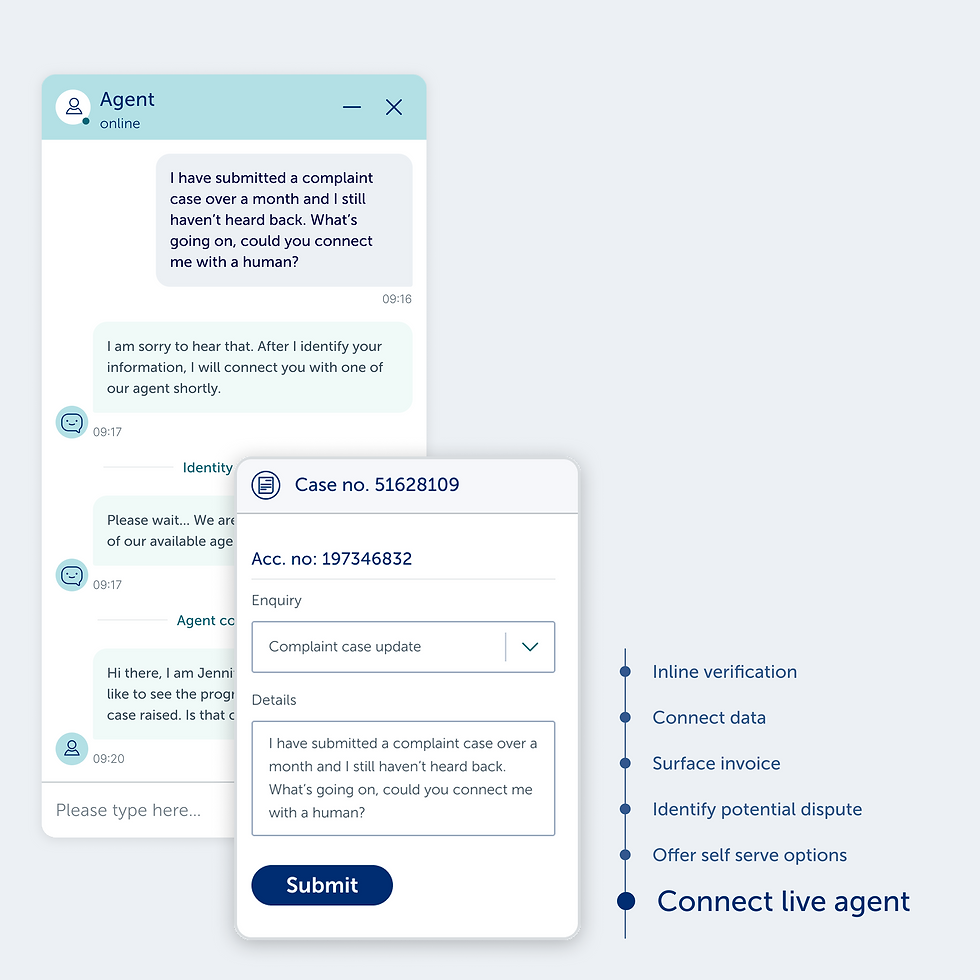
Escalation mechanism
Flag & handoff to live agent
Based on the keyword recognition and the customer sentiment analysis. AI Assistant would be able connect customers to a live agent within office hour. In addition, support customers to raise a case if it's out of office hour. The principle is not to let customers fall back with a dead end.
- 07 Outcome
Chatbot performance after live
Performance was tracked across the same funnel layers analysed in the diagnosis phase. The before/after comparison maps directly to the failure points identified in the as-is data — making the causal link between design decisions and outcomes explicit.
65%
Quick reply engagement
Up from 24%. Better button framing and contextual placement moved customers toward structured input — the interaction model that produces higher resolution rates.
32%
Verification drop off
Down from 78%. Moving authentication inline removed the structural cause of the drop-off — not the symptom.
68
Customers sentiment score
Up from 32. Positive CSAT index, driven by higher completion rates and the removal of dead-end responses from the experience.
45%
Increase in chat adoption
Growing customer confidence in the digital channel — a lagging indicator that reflects sustained improvement in resolution quality over time.
89%
Task completion rate
Up from 31%. The single largest improvement — driven by interruptible flows, inline auth, and clearer quick-reply guidance throughout the journey.
82%
Reduction in telephony and email traffic
Exceeding the 80% strategic target. Common enquiries now resolve without agent contact — the original mandate, delivered.